Friday, June 22, 2012

Kimber Kable 8PR

The construction consists of eight brown and eight black conductors, arranged in a large format braid. Individual conductors are high-purity copper. The aggregate wire size is two 10 awg conductors. 8PR provides a sound that is full bodied and powerful, making it ideal for subwoofers and the low frequency section of bi-wired speakers as well as full range applications.

  • SpadeSpade

  • SBANSBAN

  • Postmaster 25Postmaster 25

  • Postmaster 33Postmaster 33

  • Postmaster N3Postmaster N3

  • Basic Electrical Specifications

    8PR

    DUT: 8PR 2.5m bare wire ends.
    (Cp) parallel capacitance:742.0 pF @ 20 kHz
    (Ls) series inductance:0.459 µH @ 20 kHz
    (Rdc) dc loop resistance:0.021 Ω
    (Xt) total reactance:0.057 Ω @ 20 kHz
    Frequency response ± 0.5 dB: dc - 50 kHz

    Integra CDC-3.4 CD Player

    Integrity, the namesake of the integra brand, is defined as "a rigid adherence to a code or standard of values." that’s exactly what you get with the cdc-3.4 cd changer. The best parts, technology and engineering come together to bring you an unparalleled music listening experience.
    Integra was the first company to offer an exclusive 6-disc carousel in a CD changer. The tradition continues with the newly redesigned CDC-3.4. It features smooth & quiet mechanical operation, plus a soft blue light which illuminates the disc tray for better visibility. You can also load up to 5 discs while one is still playing for extended listening times without interruption.
    We've taken the best digital-to-analog converters and combined them with our exclusive VLSC noise reduction circuitry and 8x oversampling for the clearest possible sound from the analog outputs. For digital signals, a "Direct Digital Path" is used to carry the signal to the player's coaxial digital output. This provides a more direct signal path to your receiver via a heavily shielded cable.
    The CDC-3.4 is truly "Designed to Integrate" — it communicates flawlessly with third-party automation and control systems. It also boasts a family of nine discrete IR code sets, allowing control of several units in a single location with no "cross-talk" between components.

    Specifications

    CDC-3.4
    6-Disc Carousel Changer

    Digital Filter
    352.8 kHz, 128 x oversampling
    Frequency Response
    5 Hz-20 kHz
    S/N Ratio
    98 dB
    Dynamic Range
    96 dB
    THD (1 kHz)
    0.005 %
    Channel Separation (1 kHz)
    92 dB
    Wow and Flutter
    Below threshold of measurability
    Dimensions (W x H x D)
    17 1/8" x 5 3/16" x 17 3/16"
    Weight
    15.0 lbs./6.8 kg

    Thursday, June 21, 2012

    How Many Channels of Surround Are Too Many?

     Dolby Pro Logic in the 1980s significantly laid the groundwork for over two decades of boom times in the home theater market. 5.1 discrete surround sound had less and less compression in the form of Dolby Digital (AC3) and DTS fueled the popularity of DVD-Video all through the 1990s. In the mid-2000s 7.1 surround sound, complete with its side channel surround speakers, eked its way into the feature-laden receiver market and consumers sighed. HDMI never worked correctly and 7.1 only added more complications but over time most home theater enthusiasts couldn't live without 1080p video and literally uncompressed 5.1 and or 7.1 surround sound in the form of DTS-HD Master Audio and/or Dolby TrueHD - so they upgraded again. Today, the latest and greatest receivers are promoting 9.2 channels of surround sound including height channels as well as stereo subwoofers. In the midst of a nasty recession, consumers and reviewers alike are asking - when is enough enough when it comes to surround sound?
     I am not saying they love HDMI because they don't, but if it worked it would have been what the computer industry likes to call "the killer application." When it comes to 9.2 surround sound - new receivers have more of a good thing to sell to consumers. Consumers get more for their receiver dollar. They ultimately buy more speakers. Customers have more ways to realize the potential of Blu-ray in most home theater environments. This, for AV retailers, is something very compelling to sell even if consumers are getting a little wary of the upgrade path.

    Consumers were confused to the core back in the 1990s when the AV powers-that-be decided to come out with 5.1 surround, as it wasn't really clear what a "point one" channel was. After more than a decade of advertising, promotion and education - everyone who loves home theater and movies knows what 5.1 or 7.1 surround sound is. However at 9.2 speakers, the question consumers are asking is - do I really need this? The short and honest answer is "not necessarily all at once." Most uncompressed surround sound tracks in Dolby TrueHD and/or DTS Master audio are in 5.1 or sometimes 7.1 surround. The extra front height channels and other subwoofers are matrix surround sound channels that add to the experience. The key idea for consumers is that they should build systems that are rock solid around their 5.1 speaker system even if their receivers are 7.1 or 9.2 channel capable. The idea of an upgrade path drove growth in the audiophile market from the 1970s through the early 1990s and it is important in the world of home theater today. If there is room and budget, side channel speakers make for a very nice upgrade that is pretty affordable. Remember to pre-wire for such an upgrade when your theater goes in. Before I would do front height channels for 9.2 surround - I would add a second subwoofer to a 7.1 system (I guess that makes it 7.2) as in most rooms an additional subwoofer can make far more impact - especially when there is auto-EQ systems built into your receiver.

    The power of a second sub can physically and audibly rock your world. The "Nth" level of performance can come from height channels and makes for an extreme upgrade. Today's in-ceiling speakers from the likes of Nobile Fidelity, Paradigm and many others come to mind as an unobtrusive way to add even more fantastic levels of high end polish to an already cutting edge home theater system. Just don't get caught up in the number of speakers in a surround system to the detriment of the core 5.1 system, including speakers, processor amps and source components.by Jerry Del Colliano

    Wednesday, June 20, 2012

    What To Look For When Buying a Home Theater System

    A surround sound system turns a television into a home theater. Without it, you can never approach the audio experience intended by modern-day filmmakers. Sure, your HDTV can probably fake surround, but it's not going to sound like the real thing.

    That real thing requires a receiver  and several speakers. YouReceiverReceiver can buy everything in a single package, or get the receiver separately from the speakers You'll get a better deal if you buy everything in one package, although hardcore audiophiles usually prefer to buy them separately.

    Your receiver will process audio information from your DVD or Blu-ray player, as well as your DVR. You might also want it to process audio from your iPod, smartphone, tape deck, and turntable.

    It must be able to send its amplified audio to at least five satellite speakers--the smallish ones that allow the sound to come from different directions--and one subwoofer.

    The receiver will also need multiple HDMI inputs, as wellHDMIHDMI as other inputs for older technology. And it will need one HDMI output, so it can send the video information to your HDTV while rerouting the audio to your speakers.

    Your receiver should also decode Blu-ray's high-quality formats, such as Dolby TrueHD and DTS-HD Master Audio.

    Do you need a 7.1 system, or is 5.1 sufficient? In a 5.1 configuration, you have three front speakers near the television (left, center, and right), two surround speakers beside the audience (left and right), and a subwoofer for the low-frequency enhancement track (LFE). For 7.1, you get four surround speakers, so that you can get different sounds behind and beside you.Speakers5.1: Five satellite speakers and a subwoofer

    As I write this, few 7.1 mixes are available, but that's changing. I don't consider 7.1 absolutely essential, but if your theater room is reasonably deep, 7.1 may enhance some movies. I'm happy with 5.1, myself.by lincoln spector

    Tuesday, June 12, 2012

    Runco QuantumColor Q-1500d & Q-1500d ULTRA


    QuantumColor™ Q-1500d and Q-1500d Ultra

    Product description


    Runco's revolutionary QuantumColor™ projectors pair energy-saving LED technology with proprietary Runco engineering to create unsurpassed performance and unrivaled customization. The Runco QuantumColor Q-1500d home theater projector maximizes the benefits of Runco’s new InfiniLight™ lampless LED illumination technology and pairs it with the proprietary Runco
    Brightness Acceleration Engine™ to produce large-screen, bright images making the Q-1500d the brightest LED home theater projector available in the world.

    The Q-1500d is an energy-efficient projector with the widest color gamut ever available in home theater projection. But simply creating a projector platform with lampless technology and the largest color gamut isn’t enough. Harnessing its incredible color options, Runco introduces its revolutionary new Personal Color Equalizer™, which allows color adjustment that includes those exactly defined by the cinematographer and the color preferences of each individual viewer for each source. Proprietary Runco Smart Color (RSC™) provides a hue compensation curve and gamut mapping that allows for lifelike, accurate flesh tones while increasing color saturation, without sacrificing the purity of other colors

    The Q-1500d’s unparalleled brightness is both a combination of Runco’s new Brightness Acceleration Engine and a phenomenon called Q-lumens. Q lumens enable the Q-1500d to outperform its specifications. To learn more about Q lumens, read Runco’s eBook “Out-of-the-Box Brightness for Life™.

    Sunday, June 10, 2012

    BANG & OlUFSEN BEOLAB 12

    Design is nothing without performance


    The wave pattern creates a structure that is inconspicuous and sleek. But its compact shape does not sacrifice performance or acoustic perfection. BeoLab 12 exploits every inch of the slender unit to drive out incredible, multi-dimensional sound.

    An optical illusion


    BeoLab 12 features a sculptural design that forms a reassuring wave pattern. The effect of this wave design is a flat-form loudspeaker that beholds powerful capabilities, maximizing every inch of the slim space. Call it the world’s most high-performing optical illusion, because when viewed from the side, this commanding speaker appears even slimmer.

    Prick up your ears


    Hear how the superb acoustic performance of BeoLab 12 breathes new life into your favorite film or song. It elegantly stages the experience of listening, so new dimensions and layers reach your ears. Whether it is a Puccini opera, a Spaghetti western, or the sound of wind blowing, BeoLab 12 wall speaker evokes the perfect surround sound to enrich your experience, both acoustically and visually.

    Magic happens when you break the rules

    Less reflection, more realism


    With the Acoustic Lens Technology handling the treble notes and helping disperse the sound waves evenly throughout the room, we maximise space in front of the loudspeaker with optimal sound, constant tonal balance, minimised floor and ceiling reflection, and a deeper sense of space and realism.

    Playing with the wall


    The rear section of the wall-mounted BeoLab 12 is open where the woofer is placed; so two woofers play directly into the wall. Because these bass units play directly into the wall – away from the listener – you get an acoustic benefit. Any audible distortion from high frequency sounds is removed.

    Features & specifications

    • beolab-12
    DesignerDavid Lewis
    Dimensions94.2 x 22 x 9.8 cm/6 kg
    Material(s)Aluminum and composite materials
    Colour(s)Cabinet/Cover: Silver/White
    Power consumptionTypical: 25 W; Networked standby: 0.4 W

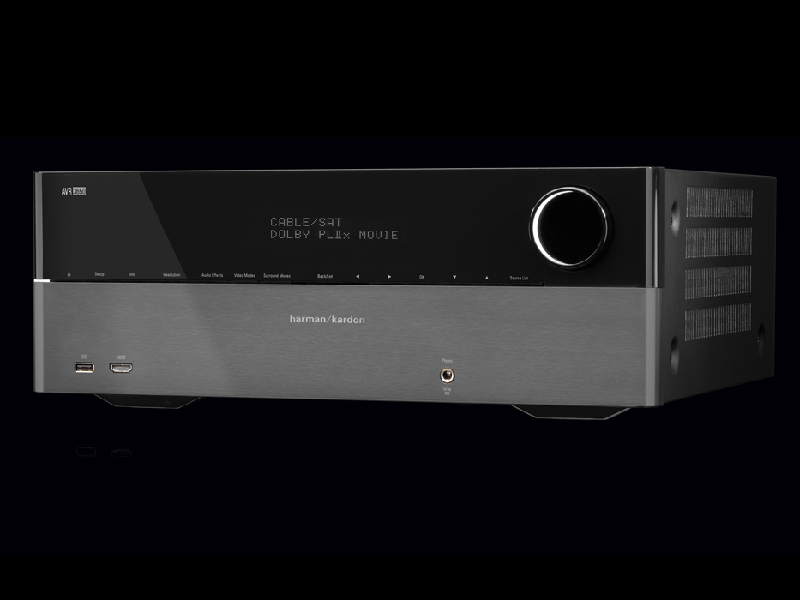
    harman/Kardon AVR 3650

    Take your home entertainment to the next level.
    If you’re looking for a receiver packed with the most sought-after home theater technologies, look no further than the Harman Kardon® AVR 3650. As an ideal starting point for building your dream home theater system, the AVR 3650 is blessed with an impressive list of features. It starts with HDMI® v.1.4a with 3-D, which allows you to experience 3-D entertainment when paired with a 3-D capable TV and 3-D sources. Then it continues on the audio front where the AVR 3650 commands serious attention with Dolby® TrueHD and DTS-HD Master Audio™ decoding – which deliver high-resolution sound that’s ultra-faithful to the filmmakers’ intentions. As an additional bonus, the AVR 3650 integrates Harman Kardon Logic 7® processing – a powerful and proprietary technology that devotes itself to each one of the seven amplified channels of surround sound the receiver is capable of supporting. Ultimately, with six HDMI inputs, extensive video and audio connectivity, and its ability to connect with a Harman Kardon The Bridge IIIP (available separately) for playback of your iPod and iPhone devices, the AVR 3650 is a brilliant performer that accommodates virtually any system you pair it up with.
    FREE Ground Shipping